
Fungi - What the Dead Tree is Doing


April 2026
There's a fallen log in the forest that I keep coming back to.
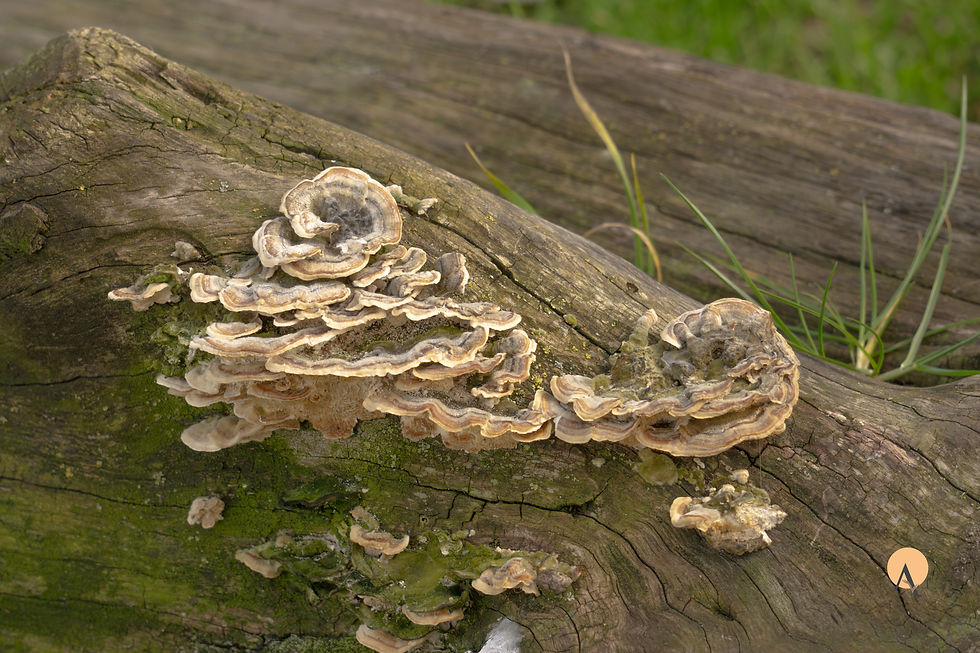
It's been down a while. Long enough that the bark has gone soft in places, long enough that moss has claimed most of the upper surface, long enough that something else has moved in entirely. Bracket fungi, spreading in overlapping tiers along the length of it, each one a small architectural marvel of concentric rings and layered edges. And on the cut end of another log nearby, something different: tiny golden fungi, just emerging, catching the low March light like they're lit from inside.
I photographed both. And then I stood there longer than was strictly necessary, thinking about what I was actually looking at.
This is Easter weekend. Good Friday, the weekend of death and what comes after, of things that seem finished, only to turn out not to be. It's a good time to think about fungi.
Because fungi are, at their core, about exactly that. They appear on what is dead or dying, and they are the mechanism by which death becomes life again. That fallen log isn't rotting away into nothing. It's being systematically dismantled, its stored nutrients unlocked and returned to the soil, made available to the living roots nearby. Fungi break down around 85% of dead plant matter in forests. Without them, fallen trees would simply accumulate. The forest floor would become a graveyard with no recycling system. Instead, death feeds life, continuously, invisibly, through networks we're only beginning to understand.
It's not a bad thing to contemplate on a spring morning.
Humans have always known, on some level, that fungi are strange. The folklore is rich and genuinely fascinating. Those circular patterns of mushrooms that appear in meadows, fairy rings, were believed across Europe to mark the places where fairies had danced through the night. Step inside one and you risked being pulled into their realm, trapped between worlds. The word "toadstool" comes from the medieval belief that toads sat atop poisonous mushrooms, the toad being a creature associated with transformation and the boundary between the living and the dead. Finding certain fungi near your home was considered an omen.

And then there were the wise women who harvested them. The herbalists, the healers, the people who knew which fungi were medicinal and which were dangerous, who understood the rhythms of the forest well enough to find what they needed, who had spent lifetimes paying close attention to the natural world before the language of science existed to describe what they were observing. History has not always been kind to them. They were called witches, a word meant to frighten, meant to dismiss. But what they actually were was early naturalists. Careful observers. People who understood that the natural world had properties and patterns worth learning, long before anyone had the tools to explain why.
The fungi they gathered were not magic. They were chemistry, ecology, medicine. The knowledge was real. Only the framework for understanding it came later.
What people were sensing, across all of this folklore, was that fungi operate by different rules. They appear suddenly, overnight, where nothing was before. They grow in patterns that suggest intention. They feed on death. They exist mostly out of sight, in forms we don't usually get to see. The visible mushroom or bracket is just the surface expression of something much larger and stranger happening beneath.
The science, when it came, turned out to be stranger than the folklore.
The mycelial networks that fungi create underground are so extensive and so functionally complex that researchers have taken to calling them the Wood Wide Web. These networks connect trees across entire forest systems, allowing them to pass nutrients to each other, including in some documented cases older trees supporting younger seedlings growing in their shade. They carry chemical signals about pest attacks and drought stress. The trees aren't just growing next to each other. They're communicating, trading, cooperating, through a fungal intermediary that takes a small cut of the photosynthesised sugar in exchange for its services.
The bracket fungi on that log are part of this. They're not separate from the forest. They're the forest's infrastructure, doing work that the whole system depends on.
And fungi are ancient in a way that's difficult to fully grasp. They've been here for over a billion years, predating the dinosaurs by an extraordinary margin. Current thinking suggests that fungi were instrumental in helping early plants colonise land, forming partnerships with plant roots that allowed those first terrestrial pioneers to extract nutrients from bare rock. The forest, in a very real sense, exists because of fungi. Penicillin, which has saved an incalculable number of human lives, comes from a fungus. Traditional Chinese medicine has used mushrooms medicinally for over two thousand years, long before Western science caught up with what those compounds actually do.
The wise women who walked these forests knew some of this, in their own way. They just didn't have the journals to publish it in.

The golden fungi I photographed, emerging from dark weathered wood in that warm amber light, are brackets of a younger, smaller species than the pale layered ones on the fallen log. But they're doing the same work, in the same network, as part of the same system that has been running largely unnoticed since long before anyone was around to notice it.
That's what I find myself coming back to with fungi, the same thing I keep finding with trees and bees and swans and goslings: the extraordinary amount that is happening all the time, quietly, without any requirement for human attention, in the ordinary places we walk past. The forest floor isn't a backdrop. The dead log isn't just dead. This Easter weekend, on a cold March morning, something golden and ancient and genuinely remarkable is pushing through the bark of a fallen tree, doing the work of resurrection as it has always done.
Worth stopping for.
Shot in March 2026. Turkey Tail fungi (Trametes versicolor) and golden bracket fungi on fallen logs.


Comments